






As published in Waste360, where it was the #2 top story in This Week in Waste.
Originally published November 2025
As the holidays approach, waste and recycling facilities continue to face a concerning pattern: fires are occurring more frequently than ever. October marked the fourth consecutive record-setting month for fire incidents in the U.S. and Canada, largely driven by improperly discarded personal storage devices or electronics containing lithium-ion batteries, which puts battery fire response in the spotlight this month.
This war against fires is being waged on all fronts. This month, I sat down with a career firefighter turned battery fire expert who has battled these fires firsthand, first with the City of Dublin, Ohio, my adopted hometown (my first love will always be Detroit) and now as the CEO of the Energy Security Agency (ESA). He offers candid advice on battery fire response and handling the personal storage devices and electronics that are overwhelming our global waste and recycling infrastructure.
October 2025 Fire Data: A Fourth Consecutive Record Month
The first half of 2025 set new and unfortunate records, marking the worst start to a year since I began tracking and reporting waste and recycling facility fire data in 2016.
July’s 56 reported fire incidents set not only the highest total ever recorded for that month but also the highest single-month total for publicly reported fire incidents in the past 10 years. August followed with 49 reported fire incidents, and September reached a new monthly high with 45 incidents. In October, there were 48 publicly reported fire incidents, outpacing the former record holder, 2022, by 10 incidents.
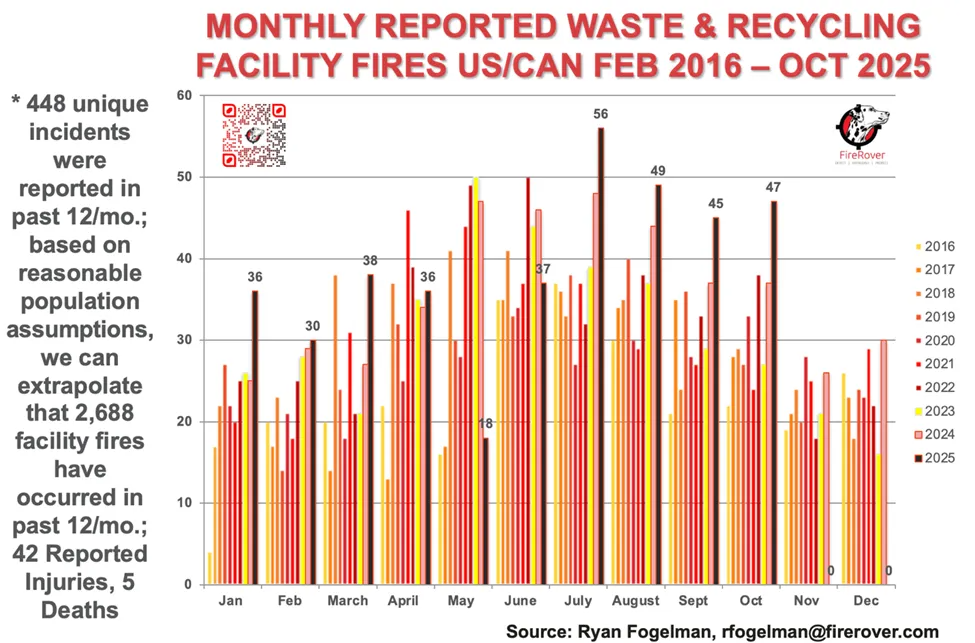 Monthly Reported Waste & Recycling Facility Fires US/CAN Feb 2016 – Oct 2025
Which Facilities Had the Most Fires in October 2025?
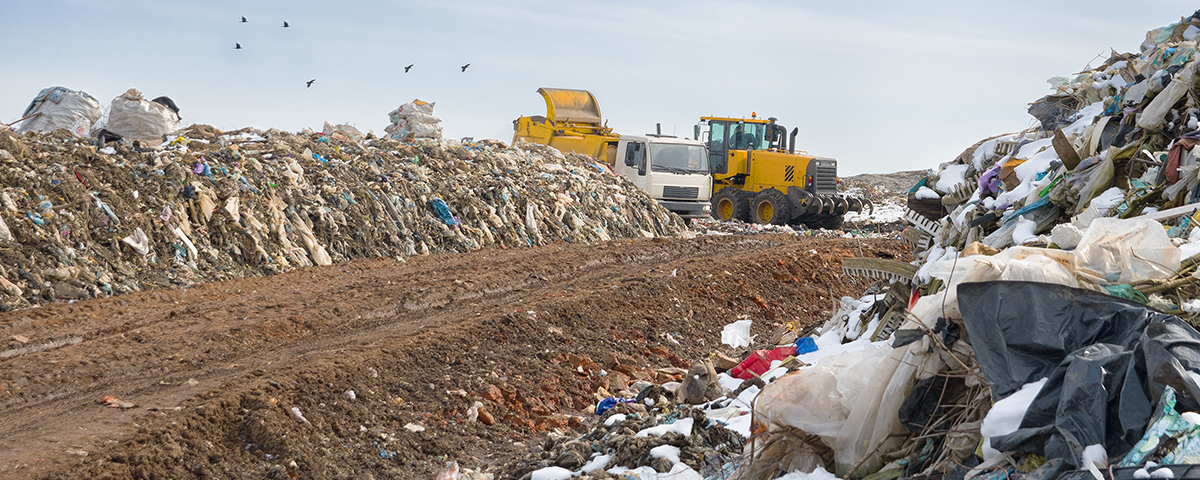
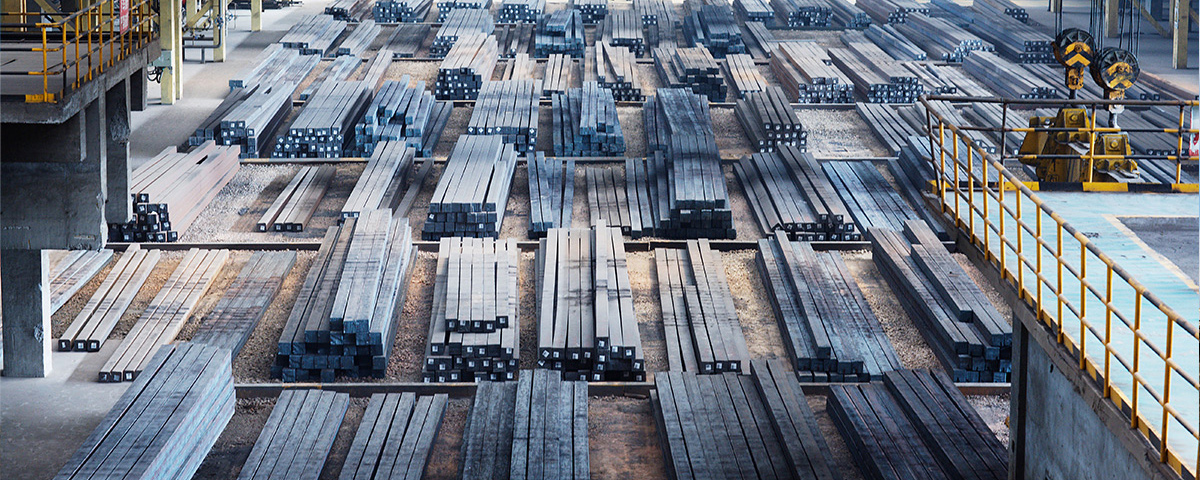
October saw another shift in the leading type of material involved in fires. Scrap metal recycling yards experienced the most incidents for the second month in a row, with 20 publicly reported fires. On a positive note, waste, paper and plastics facilities followed with only 15 incidents. Organics management facilities reported six, chemical/hazardous material facilities reported three, rubber recycling yards reported two and one occurred at a construction and demolition recycling yard.
Is the Scrap Metal Fire Spike a Trend or an Anomaly?
As mentioned in last month’s article, we need to take a hard look into the fact that scrap metal fire incidents have now outpaced waste, paper and plastic fire incidents for the second consecutive month. Since this is the first time this has happened, I conducted an analysis to determine if this is an emerging trend or just an anomaly. Last month, publicly reported fires at scrap metal recycling yards accounted for nearly 49% of all incidents, which is much higher than the historical average of about 30%.
To put this into perspective, of the 3,543 publicly reported fires since 2016, 1,127 occurred at scrap metal recycling yards. Historically, the peak years as a percentage of total fires were 2018 and 2021, with scrap metal recycling yards accounting for 40% and 37%, respectively. Based on year-to-date (YTD) numbers for 2025, scrap metal recycling yard fires remain around 30% of total publicly reported incidents, which is in line with the historical norm.
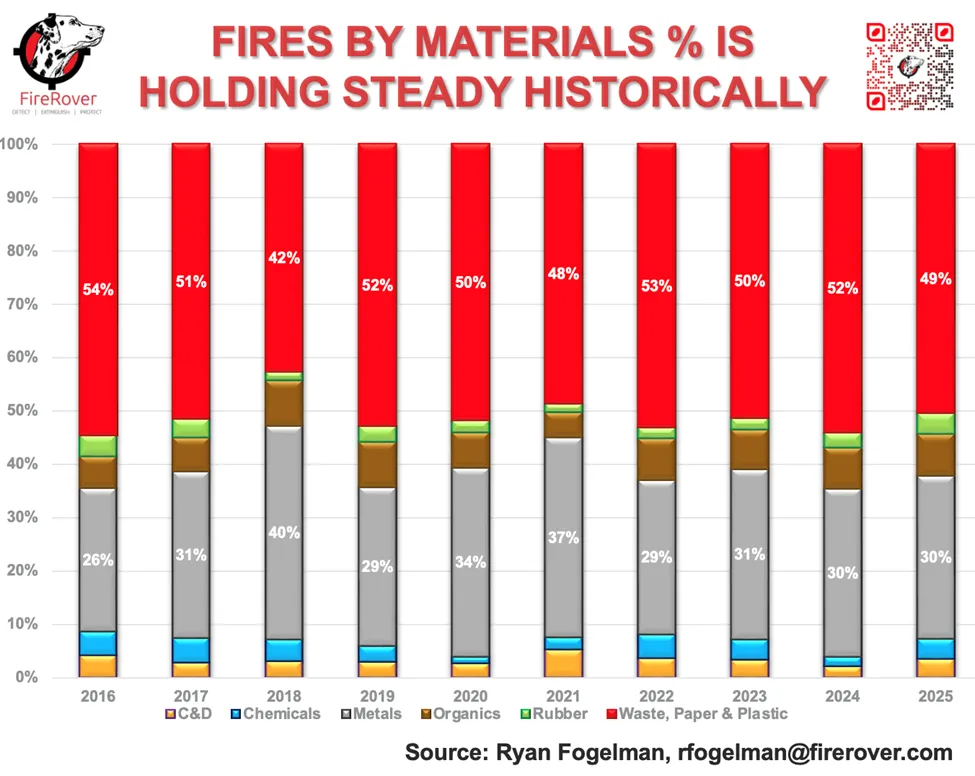 Fire By Materials % is Holding Steady Historically
While September has occasionally shown an increase in fires at scrap metal recycling yards in past years, an extension into October is not concerning, provided November and December show a slowdown. I’ll keep an eye on this pattern as we near the end of 2025, but my gut tells me it’s connected to the changing temperatures as scrap metal recycling yards transition from the warm summer months to the cooler fall months. I’d expect colder temperatures to play in our favor in the coming months.
In my last annual report, I examined weather patterns and found increased heat and dryness across the U.S. and Canada for all waste and recycling operations, as they continue to contribute to more fires. I’ll look further into this issue for my 2025 annual report, publishing in March 2026.
What This Data Means for Year-End 2025
Based on YTD data, we are entering the final quarter of the year at a record-breaking pace. Heading into November, we’re trending 18 fire incidents higher than last year. If November and December follow last year’s total of 56 incidents, 2025 could end on a high note, with 448 reported fires. On the low end, using October’s YTD total of 392 and including only the average of November and December from 2016-2024 (46 incidents), the total would be 438.
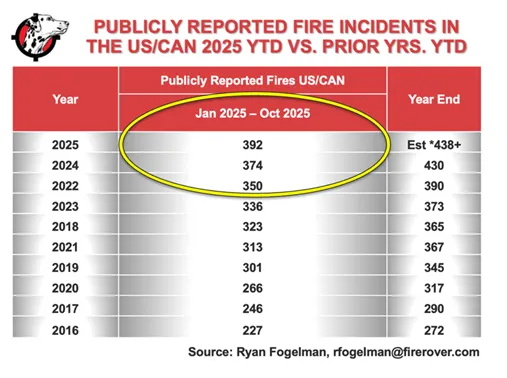
Using the prior nine years’ average, we will see a chart like the following, a best-case scenario as we have seen these numbers increasing each year since 2016.
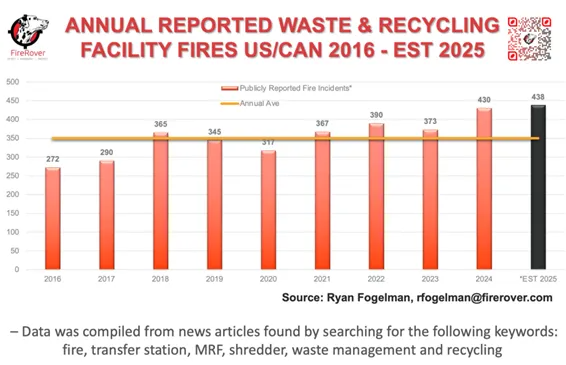
But there’s always a chance we’ll encounter a month like May of this year, where there were only 18 publicly reported fire incidents, which is less than half the monthly average from the past four years. Using these estimates, I conducted an analysis to forecast where we may end this year based on YTD data.
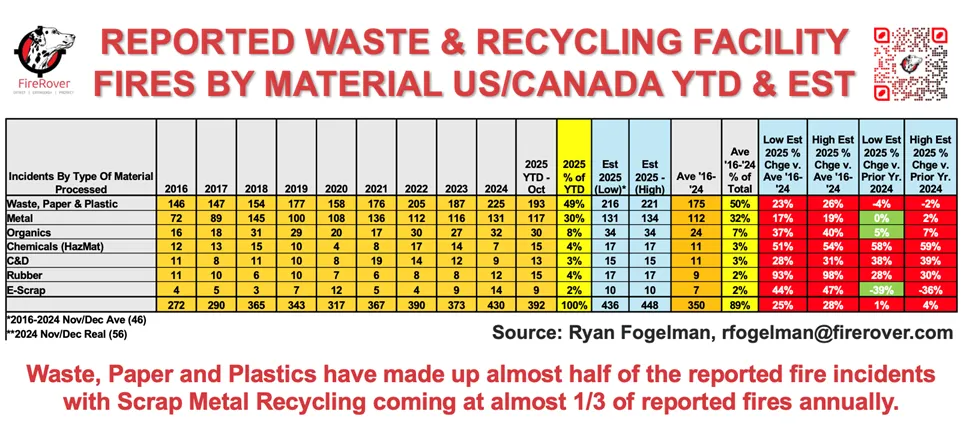 Reported Waste & Recycling Facility Fires By Material US/Canada YTD & EST EOY
As you can see from the numbers, waste, paper and plastic has continuously accounted for nearly half of reported fire incidents. To date, scrap metal yard fires are down, unless the recent trend continues. Over the past two months, the highest fire months on record, scrap metal yard fires have accounted for more than half of all incidents. The remaining categories, while much smaller, are consistent with prior-year averages.
What Fire Rover Is Seeing at Client Facilities
At Fire Rover, we’ve already suppressed more fires at client facilities in 2025 than in all of 2024. We’re currently on pace to suppress nearly 500 incidents globally this year, up from 268 in 2024. Check out our three-and-a-half-year key performance dashboard that I shared in August’s article.
Talk Fire Risk With Ryan
Ryan tracks fire incidents nationwide and helps facilities reduce risk with smarter detection and suppression strategies. Connect with him to get expert guidance tailored to your operation.
A Disturbing Trend We Need to Keep an Eye On: Fire Injuries and Deaths
As an industry, we’re fortunate that we don’t see a huge number of deaths or injuries from fires in our daily operations. That said, even one death or injury is too many, especially when they are typically incurred by the first responders who come on scene to fight major or catastrophic fires.
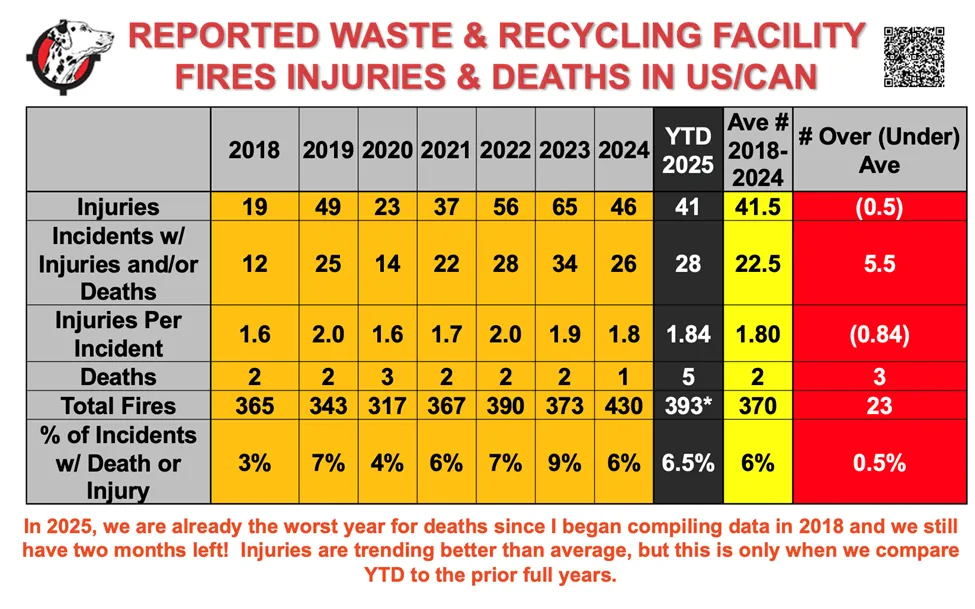 Reported Waste & Recycling Fires Injuries & Death In US/CAN Nov 2025
Although the number of injuries remains in line with historical averages, YTD data shows that we have encountered several deaths this year due to the inherent risk of fires in our operations.
Since joining the waste and recycling industry in 2016, I hope you’ve seen a consistent theme in my articles and reports: I don’t claim to be a fire expert. When I’m not qualified to speak on a subject, I turn to those who are to expand my knowledge. I believe we all benefit from hearing these experts’ experiences, insights and perspectives on these critical fire safety issues, battery fire response included.
Battery Fire Response: A Candid Discussion with Lithium-Ion Battery Frontline Firefighter Dalan Zartman
Anyone who knows Dalan Zartman as well as I do understands that he has been on the frontlines fighting fires for more than 30 years, first with the U.S. Marines, then in fire services focused on safely rescuing people from industrial hazards across the globe. For the past five years, Zartman has been the CEO of the ESA, developing expertise in best practices for combating electric vehicle (EV) and large lithium-ion battery storage fires.
I recently sat down with Zartman to get his insights on battery fire response, including handling the personal storage devices and electronics that are overwhelming our global waste and recycling infrastructure.
Do Handheld Fire Extinguishers Work on Battery Fires?
Fogelman: What’s your take on handheld fire extinguishers for battery fires?
Zartman: When dealing with electronics or small, isolated battery fires, we tell people to evacuate and call 911. But in real life, there are situations when you must respond immediately. For example, on an airplane, you have no choice but to act, so using a containment kit or small fire extinguisher is often the best and only option. Distance is your friend; the farther you can distance yourself from a fire the better.
The best approach is prevention. Avoid exposing batteries to extreme temperatures, overcharging them or leaving loose or broken wiring, as these are fires waiting to happen. Think and prepare before a fire occurs. If you break an electronic device, take it to get repaired in a timely manner. If you ignore the problem and a pouch starts to expand or, worse, if white toxic smoke appears, you only have seconds to evacuate. Cover your mouth and head as you distance yourself from the fire and call fire professionals as quickly as possible.
Which Battery Fire Response Solutions Can Operators Trust?
Fogelman: From the perspective of a waste and recycling operator, how do you cut through the noise of all the available solutions claiming to be the magic bullet?
Zartman: It comes down to trust. The only way to gain trust is to prove a solution works. In the fire service, we’re constantly approached with new and innovative solutions that might look good on paper or in certain test scenarios but may not properly work in real-world scenarios. You cannot test something once, twice or even three times and claim it works all the time. Every fire incident is different, and a solution must consistently perform under the same conditions to demonstrate its reliability.
That’s why we have codes, standards and testing agencies. These aren’t meant to make it difficult for innovative solutions to come to market; they exist because the consequences of bringing a “bad” product to market can result in hazards and displace proven solutions. Most products degrade over time, but like traditional sprinkler systems, other fire protection solutions not only have to work, but they must perform under stress and in real-world environments to be accepted by fire engineers, fire professionals and the fire industry for daily use.
Take for example EV Fire blankets. End users must understand the pros and cons of a manufacturer’s intended purpose for the product. To further explain, blankets are not created equally and there is no current certification testing standard to validate the performance of the blankets. We recently completed the National Fire Protection Association’s (NFPA) EV suppression research project. In this two-year testing process, only one manufacturer’s blanket was capable of withstanding the tests and performing as designed. Blankets are designed to contain vapor and fire which can be beneficial. However, the blankets do not stop the thermal event. By containing the vapor, the blankets can also produce highly toxic and explosive environments under the blanket that are fuel rich and are just waiting for an introduction of air to lean out and explode. Extreme caution must be exercised when removing the blankets.
Why Does Evacuation Come First in Battery Fire Response?
Fogelman: I’ve heard too many fire marshals talk about the “hero” who runs toward the fire instead of evacuating. What are your thoughts?
Zartman: It comes down to sympathy and empathy. Movies often portray firefighters as heroes who run into disasters and come out unscathed, but in the real world, risky behavior such as that can lead to serious injuries or even death. We take calculated risks and value lives over property. That doesn’t mean we don’t want to protect businesses; it means we understand businesses can be rebuilt and people cannot.
Even with calculated risks, unknown dangers remain. Therefore, we need to develop processes and procedures to effectively deal with those risks, even if it means playing it safe.
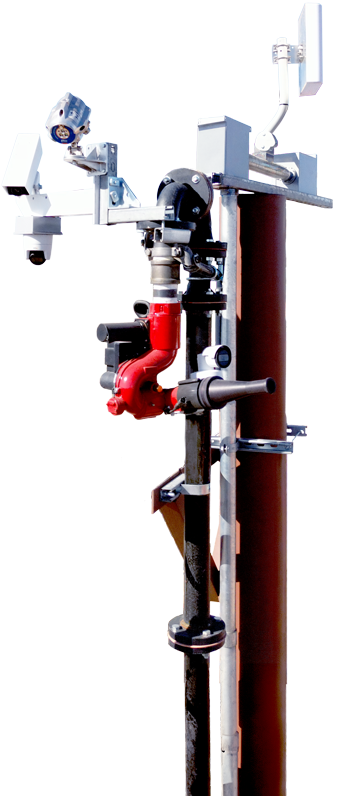
Continuous Suppression System
Eliminate threats before they spread. Our Continuous Suppression System provides nonstop, targeted suppression to keep fires from gaining ground and operations running safely.
Add a Layer to Your Battery Fire Response
Lithium-ion batteries keep arriving in the waste and recycling stream, and the safest battery fire response for your team starts with distance. The first minutes of a fire still shape how much of the operation is at risk.
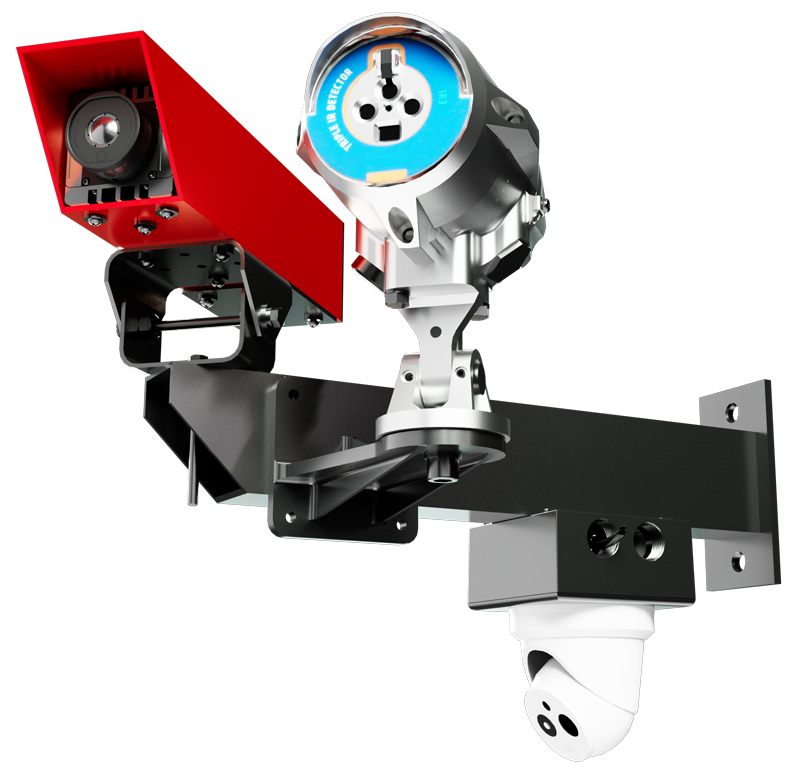
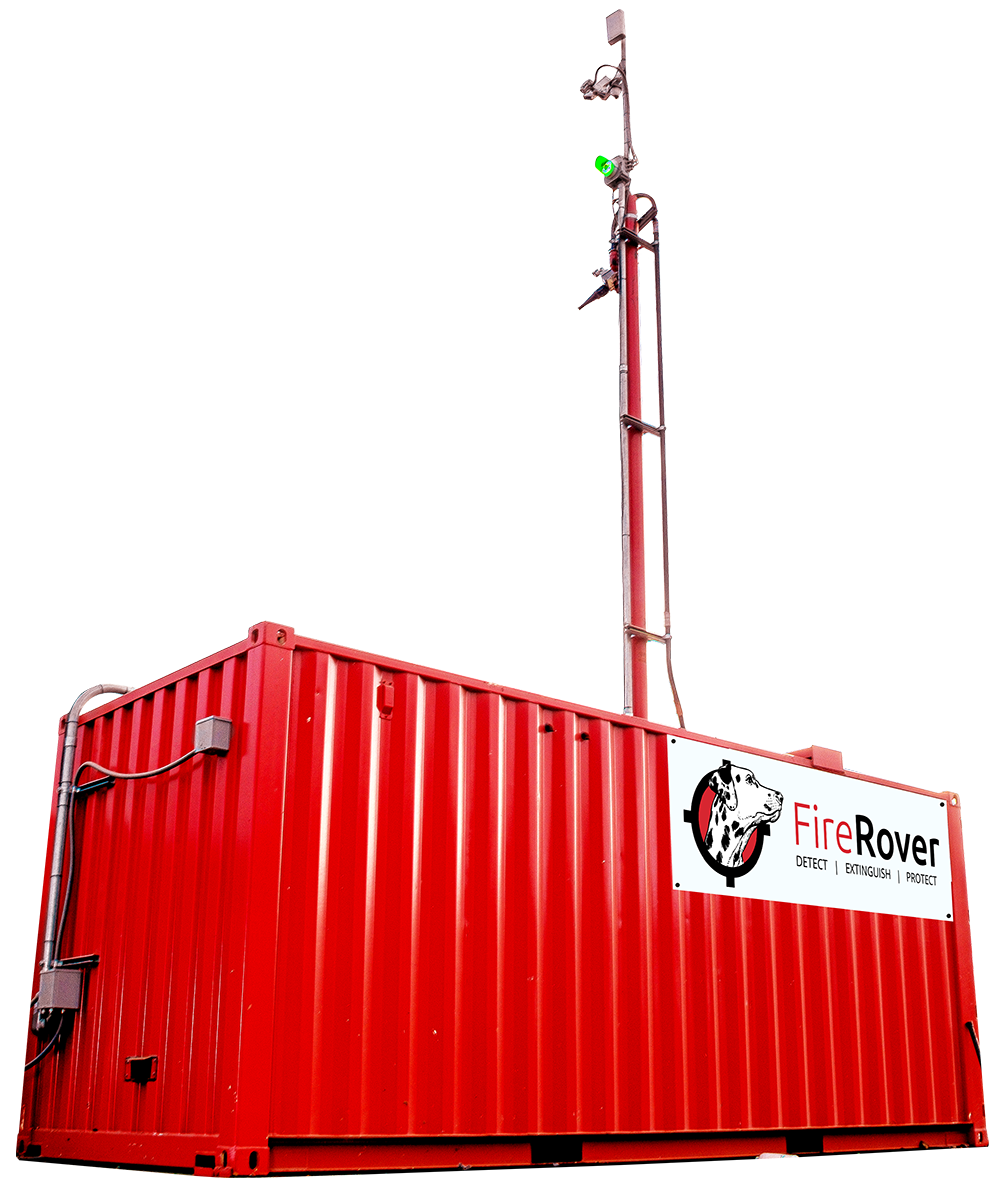
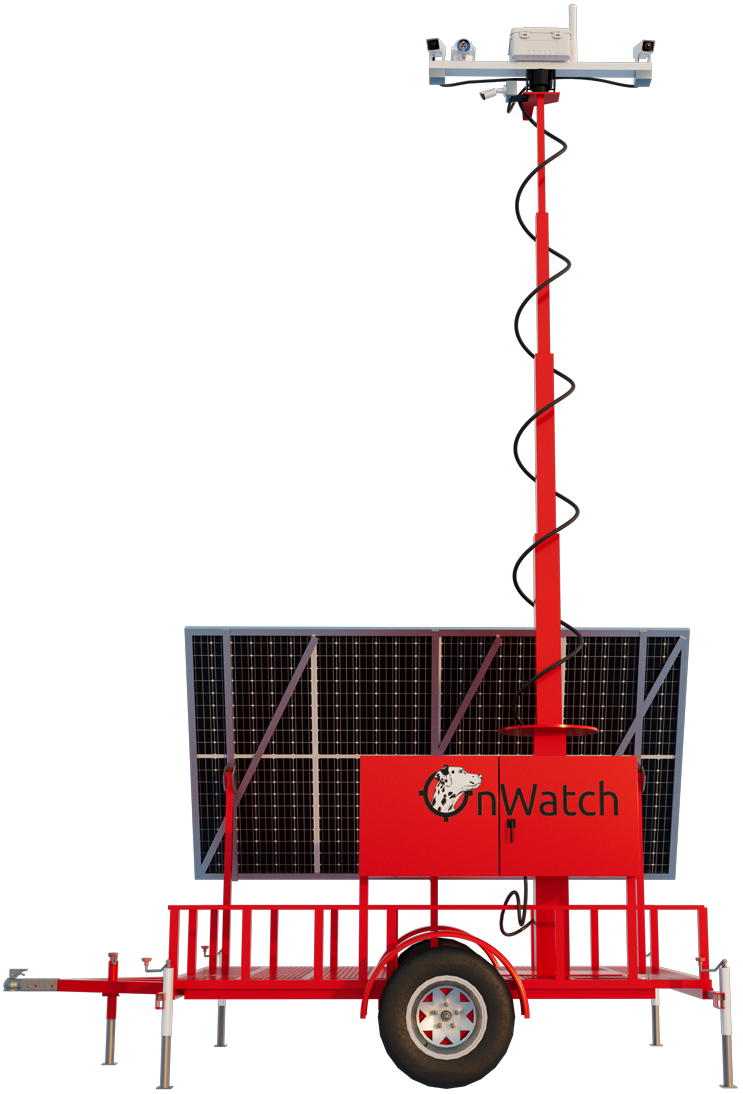
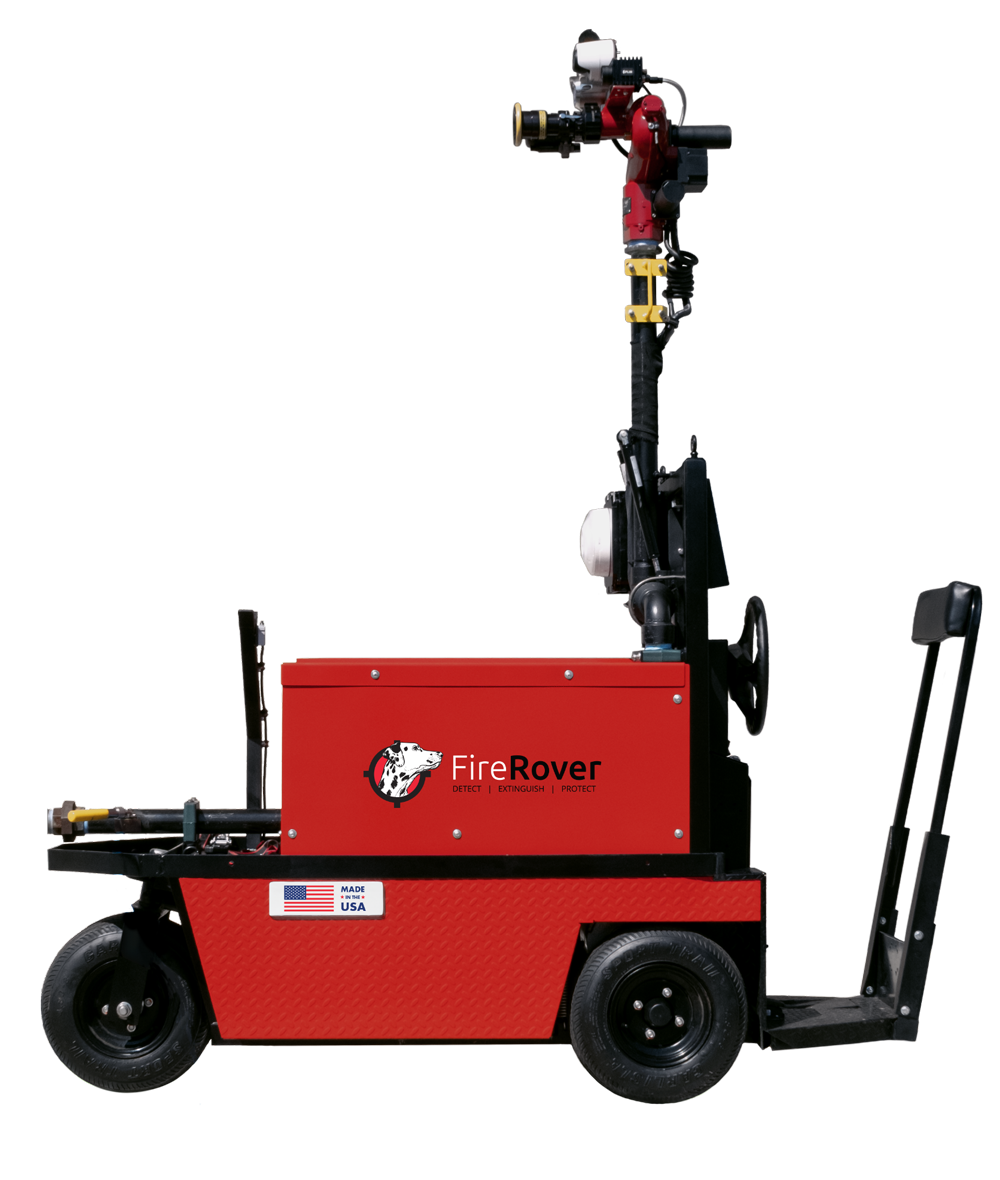
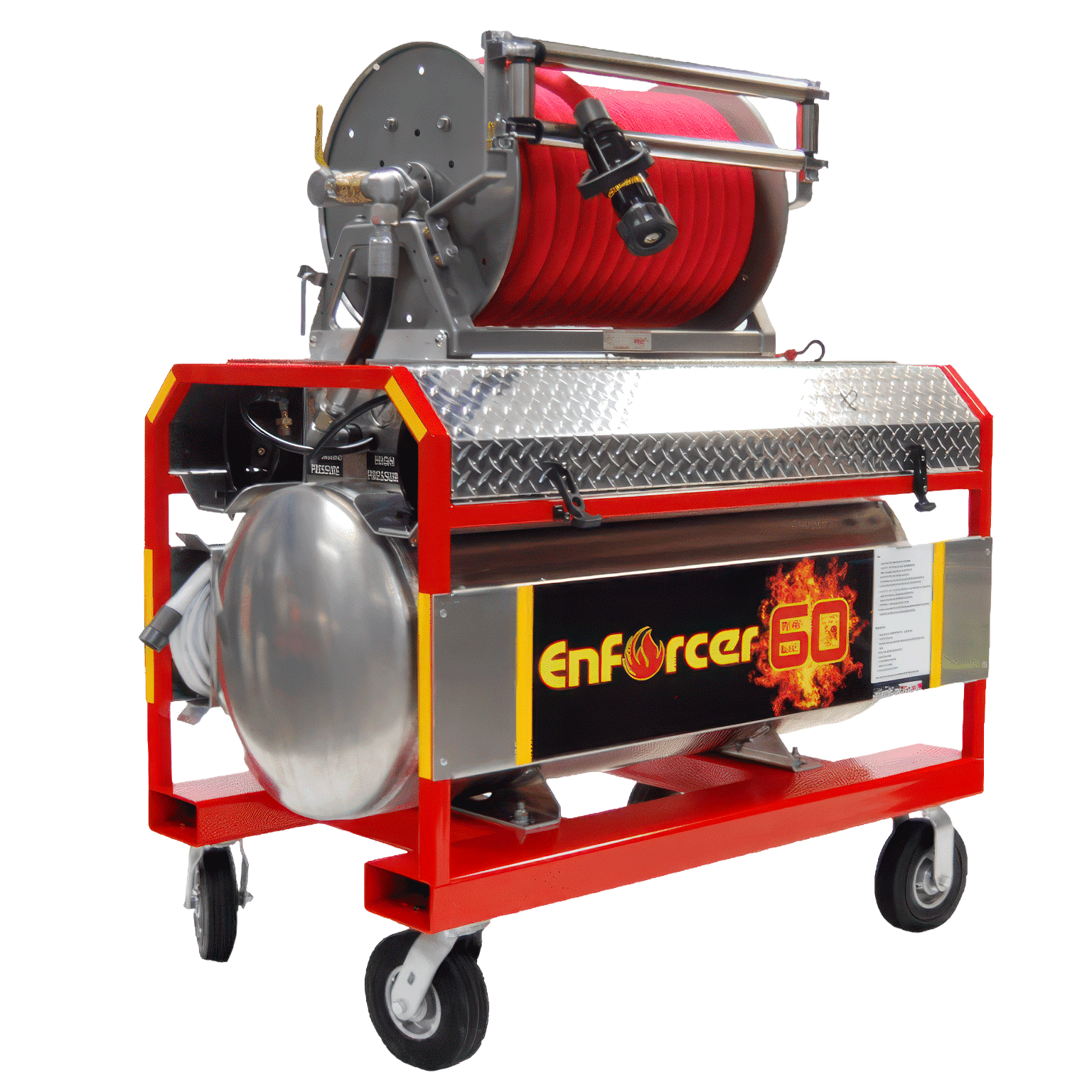
Fire Rover’s Continuous Suppression System pairs thermal detection with human verification and remotely operated suppression, so a fire can be addressed early while your team moves to safety and the fire department is on the way. Contact our team to see how it can support your site’s battery fire response plan
Related Articles
Leading Fire Protection Solutions for Private Aircraft Hangars
The Anatomy of an Electronics Recycling Fire