




As published in Waste360.
Every month, Fire Rover’s waste and recycling fire report tracks industry incident data to show operators exactly where risk is rising. The June 2026 edition confirms what the data has been signaling all year: this is not a temporary spike.
Inside the May 2026 Waste and Recycling Fire Report
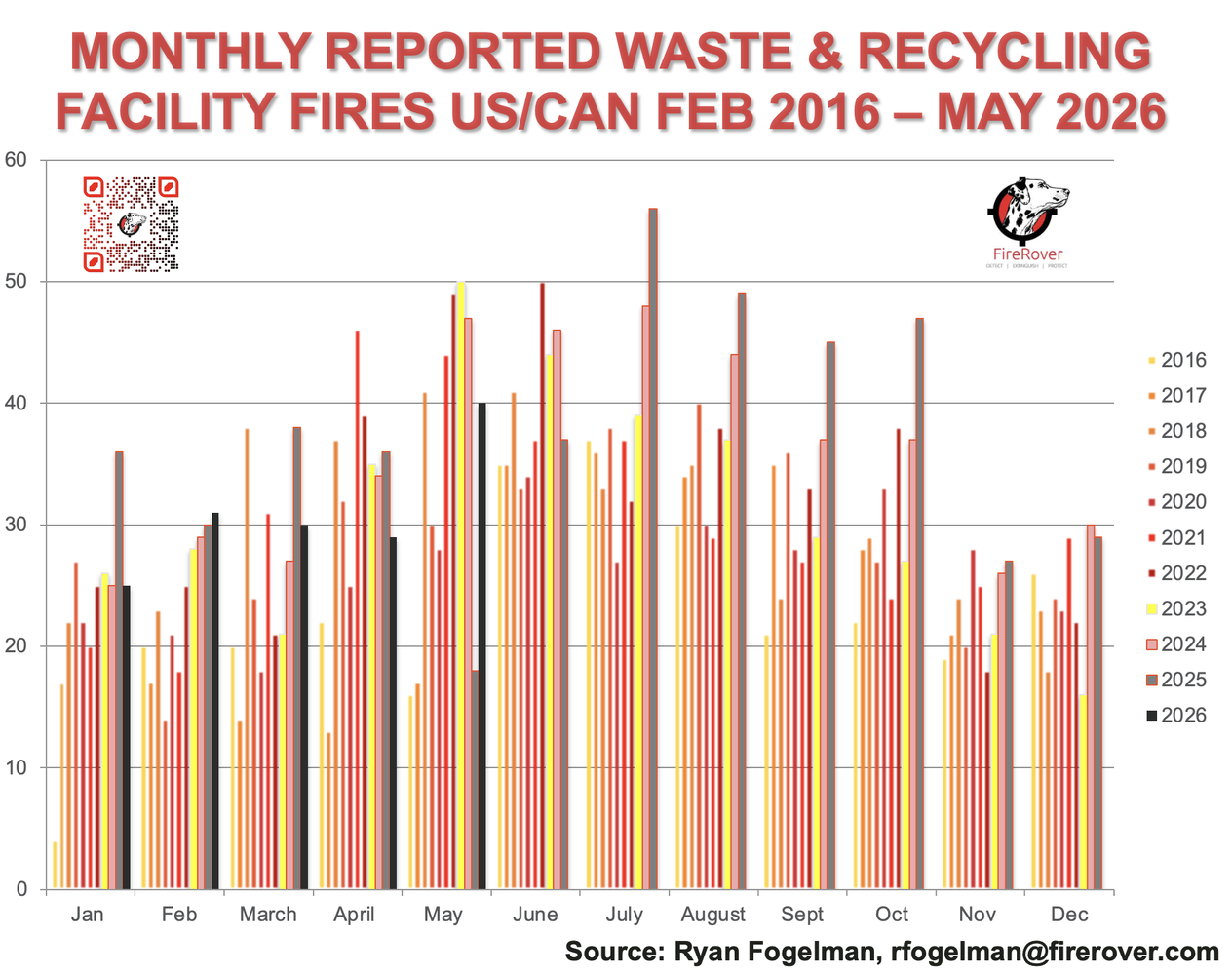
Last year, we experienced the lowest May fire count since I began reporting incident data — and for a moment, I thought we might be heading into an easier year. Then 2025 made up for that low number and then some.
 No use without express permission from Ryan Fogelman, rfogelman@firerover.com
This May, we recorded 40 incidents — six above the 2016–2025 monthly average of 34 for the month of May. Of those 40 events:
- 18 occurred at metal recycling yards
- 15 at waste, paper, and plastics facilities
- 2 at rubber facilities
- 2 at organics facilities
- 1 at a hazmat facility
- 1 at an electronics facility
Typically, waste, paper, and plastics fires account for more than 50% of monthly incidents, with scrap metal operations accounting for roughly 30%. May 2026 flipped that pattern — a notable anomaly worth tracking as we move into the traditionally higher-risk summer months.
Waste, Paper & Plastic Recycling Remains Historically Elevated
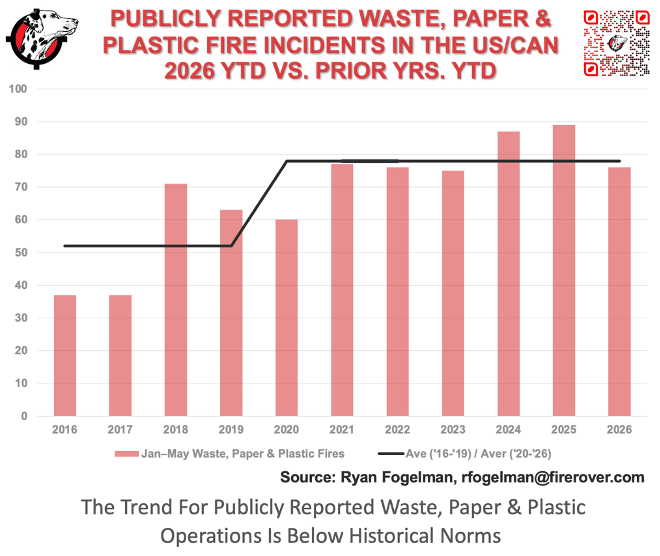
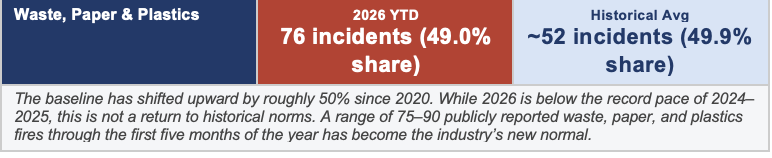
The combined Waste, Paper, and Plastics category accounts for 49.0% of all publicly reported incidents in 2026, nearly identical to its historical share of 49.9%. The category has recorded 76 incidents through the first five months of 2026, matching 2022 levels and remaining well above pre-2020 baselines.
No use without express permission from Ryan Fogelman, rfogelman@firerover.com
Looking at the chart data, two very distinct eras emerge:
- 2016–2019 Average: approximately 52 incidents through May
- 2020–2026 Average: approximately 78 incidents through May
No use without express permission from Ryan Fogelman, rfogelman@firerover.com
The important takeaway is that while 2026 is running below the record pace established in 2024 and 2025, it is not a return to historical norms. The industry has settled into a new elevated baseline.
Scrap Metal Facility Fires Continue to Gain Ground
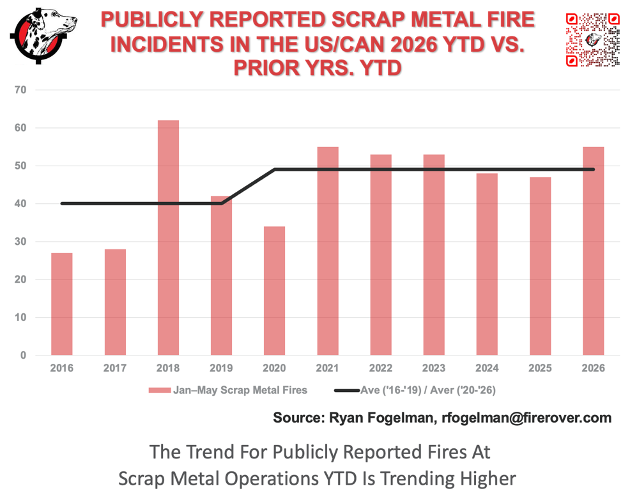
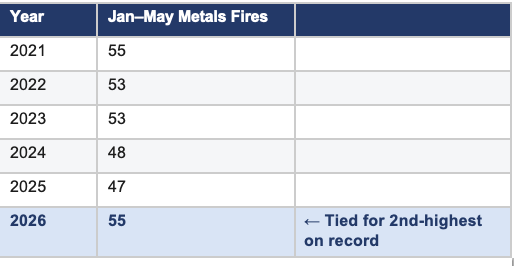
The most significant movement in the 2026 dataset is occurring in the metals sector — and it deserves more attention than it typically receives.
No use without express permission from Ryan Fogelman, rfogelman@firerover.com

No use without express permission from Ryan Fogelman, rfogelman@firerover.com
What makes this finding especially notable is the consistency of the elevated level:
No use without express permission from Ryan Fogelman, rfogelman@firerover.com
Rather than a temporary spike, metals operations appear to be sustaining a persistently elevated fire environment. The 2024–2025 dip followed by a 2026 return to 55 incidents suggests that when upstream battery contamination and processing volumes increase, metals facilities feel the impact almost immediately.
Organics and C&D Are Losing Share
Not every trend line is moving upward. Two categories are losing ground in the 2026 incident distribution:

No use without express permission from Ryan Fogelman, rfogelman@firerover.com
An important caveat: declining share does not mean declining risk. It means the growth in incidents at waste and metals facilities is outpacing other sectors. Organics and C&D operators should not interpret these numbers as a signal to reduce vigilance.
Chemicals and E-Scrap Are Quietly Increasing
Two smaller categories deserve closer attention heading into the second half of 2026:

No use without express permission from Ryan Fogelman, rfogelman@firerover.com
Neither category generates enough incidents to drive overall industry numbers, but both are trending upward. Given the increasing presence of batteries, electronic devices, and energy storage components throughout the waste stream, these increases are worth watching closely. Both categories process materials that are becoming progressively more battery-dense with every passing product cycle.
Ryan tracks fire incidents nationwide and helps facilities reduce risk with smarter detection and suppression strategies. Connect with him to get expert guidance tailored to your operation.Talk Fire Risk With Ryan
The Battery Story Is Still Emerging
Most public discussion around waste and recycling fires focuses exclusively on lithium-ion batteries. The 2026 data tells a more nuanced story.
Batteries may not be creating an entirely new fire problem as much as they are reshaping where and how fire risk manifests across the industry. The clearest evidence is the migration of incident share toward:
- Metals facilities, which increasingly process battery-containing end-of-life products
- E-scrap operations, which handle battery-dense consumer electronics streams
- Chemical and specialty recycling facilities, which are processing more battery-related materials
This shift has meaningful operational implications. A metals facility experiencing a fire in a shredder or baler faces a fundamentally different incident profile than a waste transfer station or a recycling operation. The material composition, the ignition characteristics, the suppression requirements, and the re-ignition risk are all different. Facilities in growing-risk categories need to evaluate whether their current fire protection infrastructure reflects the materials they are actually processing today — not the materials they processed five years ago.
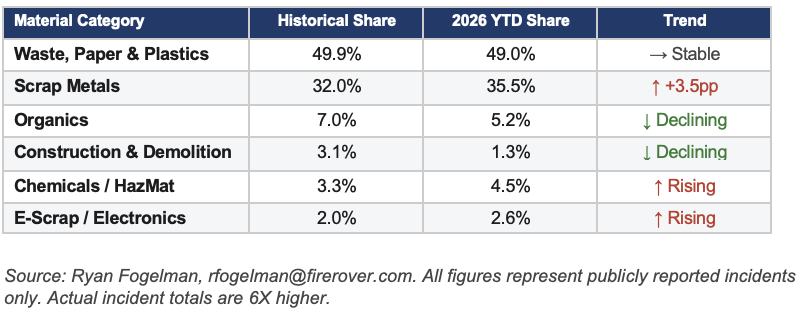
2026 Year-to-Date Incident Breakdown by Category
For a complete picture of where incidents are occurring through May 2026:
No use without express permission from Ryan Fogelman, rfogelman@firerover.com
The Strategic Takeaway
The first five months of 2026 confirm what this waste and recycling fire report has tracked all year: fires remain stubbornly elevated across North America. General waste and recycling facilities continue to account for nearly half of all publicly reported incidents. Metals operations are responsible for more than one-third and continue to gain share.
Perhaps most importantly, the data suggests the industry is no longer experiencing a temporary surge in fires. Operators are managing a permanently elevated fire-risk environment driven by increasingly complex material streams, battery contamination across more material categories, higher material densities, and continuously evolving processing methods.
The challenge facing facility operators is no longer simply detecting fires. The challenge is preventing small thermal events from becoming catastrophic losses.
As fire risk continues to evolve, the facilities that succeed will be those focused on the critical first minutes of an event: rapid identification, human verification, precise suppression, and incident management before a localized ignition becomes a total loss.
The question is no longer whether fires will occur. The question is how well-prepared your facility is to manage risk before the next one does.
At Fire Rover, we are currently on a record pace that is far outpacing the 473 fire incidents we suppressed in 2025. I look forward to sharing our half-year numbers in next month’s article.
A Major Industry Milestone: FM Approvals DS 4-14
I am proud to share a development that I believe will reshape how the waste and recycling industry — and building code officials across North America — think about fire suppression system design.
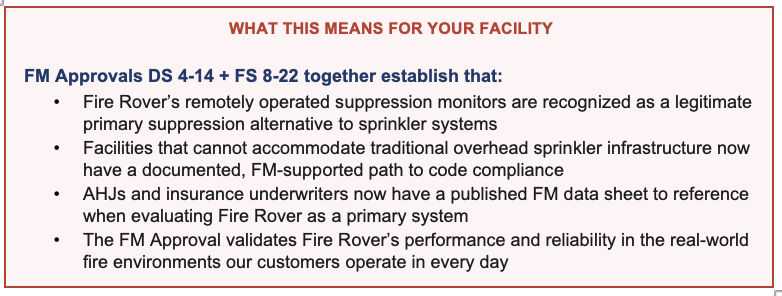
In April 2026, FM Approvals released Data Sheet DS 4-14, which explicitly states that remotely operated suppression monitors can be used in lieu of traditional sprinkler systems. When read in conjunction with FM Standard FS 8-22, this creates a clear, documented pathway for facility owners, engineers, and Authorities Having Jurisdiction (AHJ) to approve Fire Rover’s Continuous Flow primary suppression solution as a code-compliant alternative to conventional overhead sprinklers.
No use without express permission from Ryan Fogelman, rfogelman@firerover.com
This is a meaningful step forward for the entire industry. For more than a decade, operators at facilities where overhead sprinklers are impractical — due to building configuration, water supply limitations, or high-bay open spaces — have had limited options for achieving full code-compliant primary suppression coverage. That is changing.
To learn more about how DS 4-14 and FS 8-22 apply to your specific facility and occupancy type, contact our engineering team at rfogelman@firerover.com or visit firerover.com.
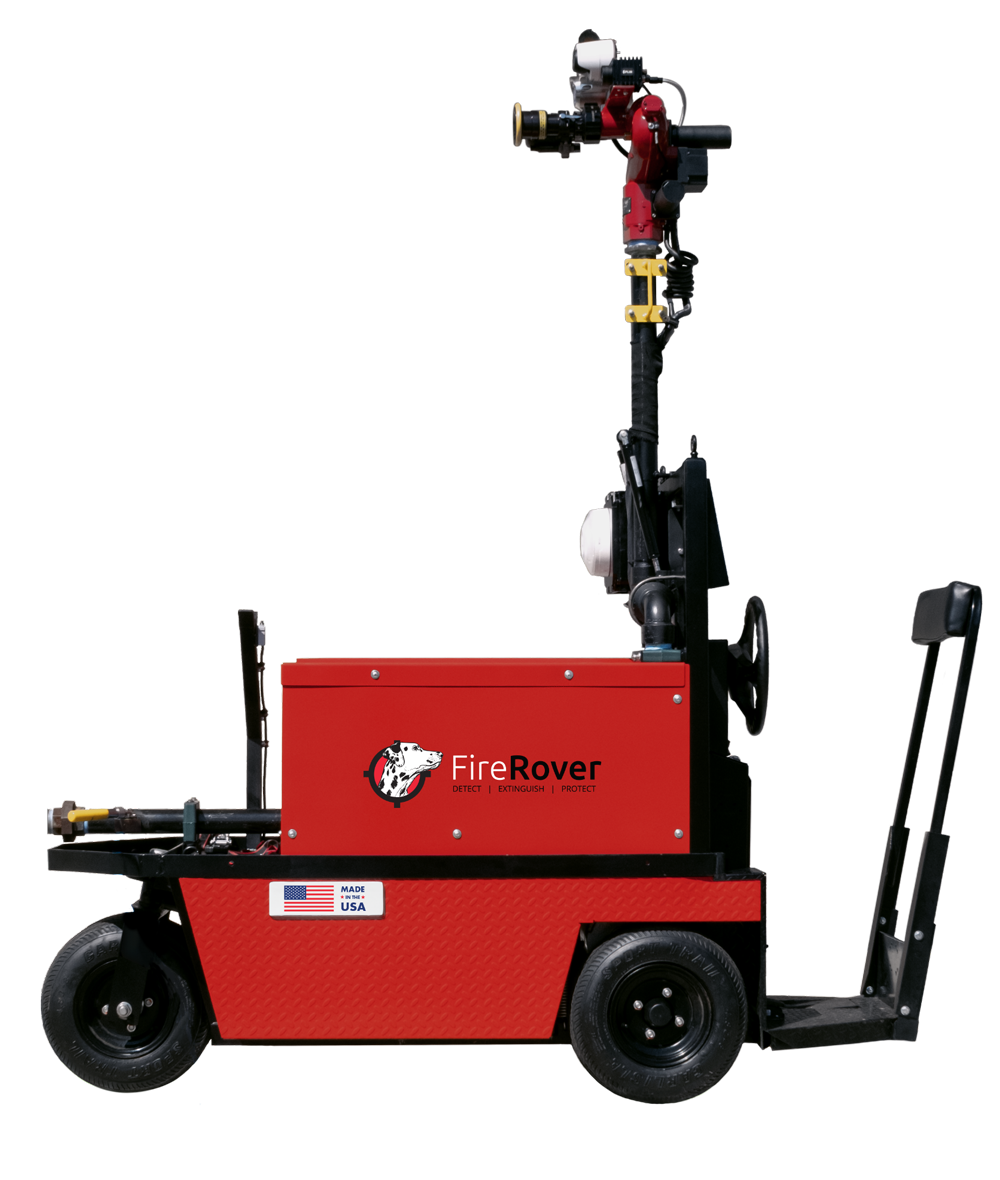
Eliminate threats before they spread. Our Continuous Suppression System provides nonstop, targeted suppression to keep fires from gaining ground and operations running safely.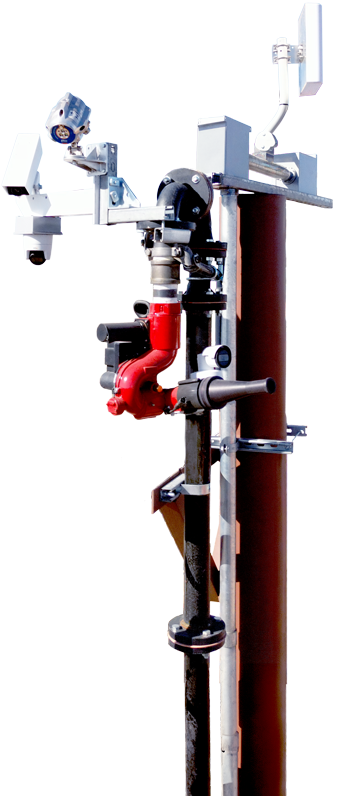
Continuous Suppression System
Join Me at the Waste Leadership Summit: Staying Ahead of the Spark
⚡️ Staying Ahead of the Spark: Lithium-Ion Battery Fire Prevention 🔥 Tuesday, June 9th | 11:00–11:45 AM EST Georgetown Room | Washington Hilton | The Waste Leadership Summit
I am looking forward to joining an outstanding panel at The Waste Leadership Summit for what I expect will be one of the most timely conversations in our industry: what operators, regulators, and technology providers need to do right now to get ahead of the lithium-ion battery fire problem.
Watch the full session video:
As battery-powered devices reach end of life in growing numbers, waste and recycling facilities are experiencing more thermal events, fires, and explosions caused by batteries that were never intended to enter the waste stream. The YTD numbers tell the story: 76 publicly reported fires at waste, paper, and plastics facilities and 55 at scrap metal yards through May alone.
During our session, the panel will discuss:
- Identifying battery risks before they become incidents
- Training employees to recognize warning signs and respond safely
- Improving collection and handling practices at every stage of the waste cycle
- Strengthening pre-incident relationships with local fire departments
- Navigating evolving regulations and industry best practices
The reality is that no single solution solves the battery problem. It requires education, better collection infrastructure, operational best practices, and technology — along with commitment from everyone in the product lifecycle, from manufacturer to end user.
I look forward to joining Kristen, Chris, and Erik for this discussion. If you are attending the Summit, and would like to connect, you can find me at the Fire Rover table located in the Main Ballroom directly to the right of the stage.
Staying Vigilant in a Permanently Elevated Environment
As we continue down this path of understanding the hazards presented by the onslaught of lithium-ion batteries in our lives and our waste and recycling streams, we all need to stay diligent and learn together. The underlying conditions that drove us to record highs have not changed. Batteries are still entering waste and recycling streams. Infrastructure to intercept them safely is still insufficient. And summer months continue to produce some of the highest incident numbers of the year.
The industry is fortifying its front lines. But we are still at war.
Whether you are processing metal, paper, plastics, municipal solid waste, construction and demolition material, organics, hazmat, chemicals, or rubber, we are all facing these risks together. The risks are increasing and compounding every day. Yet the work must continue, because there is no alternative when it comes to keeping employees, facilities, and the public safe by properly managing these materials.
I remain hopeful that we will see a reversal in these trends and one day look back on this period as an anomaly. Until then, we must stay vigilant and continue the fight.
In the meantime, if you witness a fire incident — at home, in public, at your facility, in a truck, or at a landfill — you can report it publicly or anonymously through the SWANA / Fire Rover “Advancing Safe Management of Batteries and Preventing Fires” portal. Your participation helps raise awareness and advances the exchange of best practices that can move the needle on reducing incidents across the industry. For more information about how to keep your facilities protected around the clock, contact us today.
Related Articles
Leading Fire Protection Solutions for Private Aircraft Hangars
The Anatomy of an Electronics Recycling Fire